Short Answer: Peter Pan from the movie "Peter Pan."

Peter Pan Movie Fun Facts

Disney (1953)

Here are some of the most popular quotes from J.M. Barrie’s Peter Pan. We’ve ranked them roughly by popularity, focusing on the top 10

  1. “Stars are beautiful, but they may not take part in anything, they must just look on forever.”
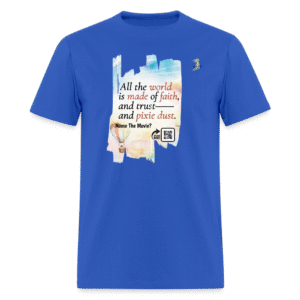
  2. “All the world is made of faith, and trust, and pixie dust.”
  3. “All children, except one, grow up.”
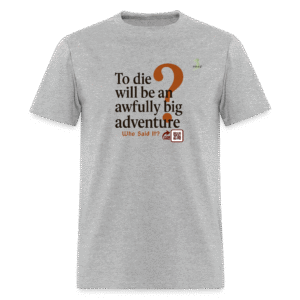
  4. “To die will be an awfully big adventure.”
  5. “The moment you doubt whether you can fly, you cease for ever to be able to do it.”
  6. “Dreams do come true, if only we wish hard enough. You can have anything in life if you will sacrifice everything else for it.”
  7. “When the first baby laughed for the first time, its laugh broke into a thousand pieces, and they all went skipping about, and that was the beginning of fairies.”
  8. “Wendy, one girl is more use than twenty boys.”
  9. “Second star to the right and straight on ’til morning.”
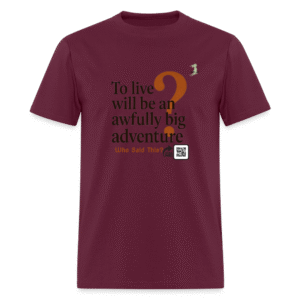
  10. “To live will be an awfully big adventure.” (2003 film Peter Pan and in the 1991 film Hook)
     

    Here are some more fun facts about Disney’s 1953 animated film Peter Pan:

    • As a young boy, Walt Disney saw a touring production of Peter Pan, and he later played the title role himself in a school play.
    • The characters of Mr. Darling and Captain Hook were both voiced by the same actor, Hans Conried, whose appearance even inspired their designs in the film.
    • This was the last Disney animated feature where all of Walt Disney’s legendary “Nine Old Men” animators worked together as directing animators.
    • Bobby Driscoll, the voice of Peter Pan, was only 16 years old during recording and had previously starred in Disney’s Song of the South while also voicing Goofy Jr. in other projects.
    • It marked the final Disney film distributed by RKO Radio Pictures, as Walt Disney established his own distribution company, Buena Vista, shortly after.
    • To secure the rights, Disney negotiated a deal with London’s Great Ormond Street Hospital, which owns the perpetual rights to J.M. Barrie’s original story and continues to benefit from royalties.  
    • Disney’s 1953 animated film Peter Pan employed several key animation techniques that were hallmarks of the studio’s golden age, building on refinements from earlier features like Cinderella and Alice in Wonderland. Here’s a breakdown of the primary methods used:
      • Hand-Drawn Cel Animation: The film was created using traditional hand-drawn animation on celluloid sheets (cels), where animators sketched and inked characters frame by frame. This technique allowed for fluid motion and expressive character designs, with backgrounds painted separately and composited. It was the last Disney feature where all of Walt Disney’s “Nine Old Men” (the core group of animators) contributed as directing animators, showcasing their expertise in character movement and personality.
      • Live-Action Reference Footage: To achieve realistic and dynamic movements, especially in flying and action sequences, animators relied heavily on live-action models as references rather than direct tracing (rotoscoping). Actors like Bobby Driscoll (voice of Peter) and dancer Roland Dupree were filmed performing scenes, providing guides for poses and timing. For Tinker Bell, actress Margaret Kerry posed with oversized props (like a giant key or scissors) to model the fairy’s sassy movements, which animator Marc Davis then translated into animation. This approach helped capture natural human (and fairy) gestures without the stiffness sometimes associated with full rotoscoping.
      • Rotoscoping for Specific Effects: While not used extensively for characters, a form of rotoscoping was applied in certain scenes. Live actors were filmed in costumes, and animators traced over select frames to ensure accurate physics, particularly for complex interactions like sword fights or group flights.
      • Application of the 12 Principles of Animation: The film exemplified Disney’s foundational principles, such as squash and stretch (seen in the children’s jumps during “You Can Fly”), anticipation (building up to flights), and overlapping action (e.g., flowing hair and clothing during movement). These techniques added weight, timing, and appeal to the characters.
      • Special Effects and Compositing: Sparkling pixie dust and glowing effects for Tinker Bell were hand-painted with airbrushing and overlays, enhancing the magical elements. The film’s vibrant colors and detailed backgrounds were achieved through multi-layer compositing, contributing to its visual mastery.

      Overall, these techniques reflected Disney’s peak technical proficiency in the 1950s, blending artistry with innovation to bring J.M. Barrie’s story to life.



Sign-Up!

Join our vibe: Get insider emails on fresh boho t-shirts and deals – unlock your free-spirited style today!

Privacy Policy

Shopping Cart