
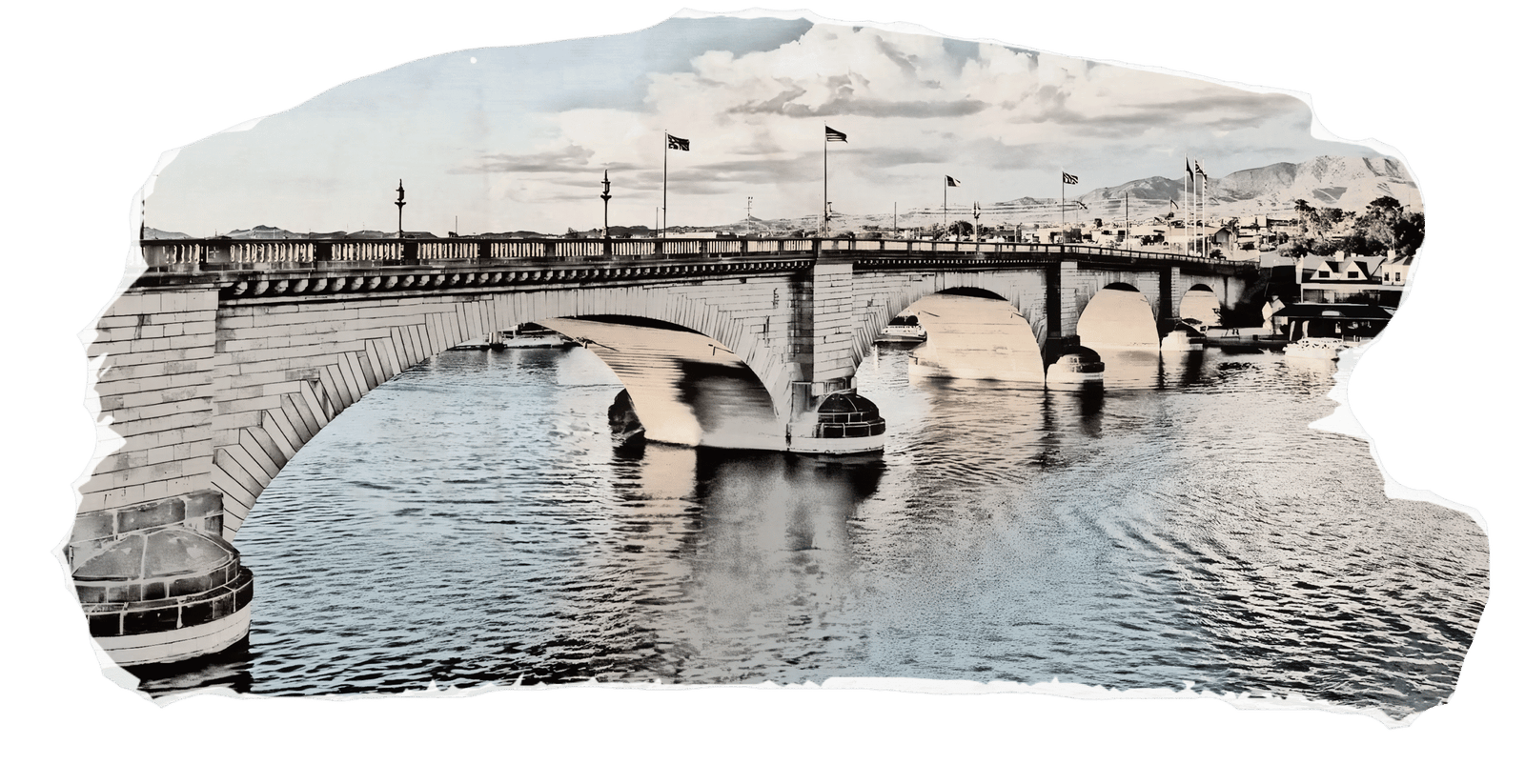
Short Answer: Lake Havasu City, Arizona.
Read the full story below.
They Shipped Me Off Across The Lake!
Beneath London’s brooding, mist-wreathed skies, where the River Thames slithered like a silver serpent through the city’s ancient heart, the London Bridge of 1831 stood as a monument to human defiance. Its five granite arches, hewn from the rugged cliffs of Dartmoor, gleamed dully under the city’s perennial fog, each stone etched with the scars of a century’s storms.
Designed by the legendary engineer John Rennie and completed by his son, John Rennie the Younger, the bridge was a symphony of precision and pride, its silhouette a steadfast sentinel against the Thames’ restless tides. For 136 years, it bore the clatter of horse hooves, the shouts of fishmongers, and the laughter of children skipping across its span, their voices weaving an ancient nursery rhyme into the air: “London Bridge is falling down, falling down, falling down…” The song, a haunting thread in London’s folklore, whispered of collapse and ruin, echoing the fates of the bridge’s timber-and-stone ancestors, each lost to fire, flood, or time’s cruel hand.
Yet this bridge, with its iron heart and granite skin, stood resolute—until the 1960s, when the rhyme’s prophecy began to stir. The bridge was crumbling, its foundations sinking into the Thames’ muddy embrace, unable to bear the roar of modern lorries and buses. The City of London, with hearts heavy as the river’s silt, resolved to dismantle it, unaware that its stones were destined for a journey as wild as the song itself, to a sun-scorched desert across the sea.
Half a world away, in the parched wilderness of Arizona’s Lake Havasu City, Robert P. McCulloch, a tycoon with eyes like burning coals and dreams as vast as the horizon, stood on his 3,353 acres of sun-baked earth. The Colorado River, a turquoise ribbon slicing through the desert’s ochre expanse, cradled his vision: a retirement paradise of palm-fringed streets and shimmering waters.
But his land was a forgotten speck, a mirage in the sand, lacking the magic to lure buyers from America’s bustling cities. One sweltering evening in 1967, as the desert sky blazed crimson and the air hummed with cicadas, McCulloch sat with his real estate agent, Robert Plumer, a man whose sly grin hinted at madness. Over the clink of whiskey glasses and the flicker of a lone candle, Plumer leaned forward, his voice a conspiratorial hiss. “Bob,” he said, “what if we brought London Bridge to Arizona?” McCulloch’s laughter erupted like thunder, shaking the room’s wooden beams. “That’s the craziest idea I’ve ever heard,” he roared, his breath stirring the desert dust on the table.
But Plumer’s eyes gleamed like polished obsidian, painting a vision of ancient stones rising from the sand, the nursery rhyme’s lament—“London Bridge is falling down”—reborn as a siren’s call to the curious and wealthy. The idea was lunacy, a fever dream under the desert stars, yet it burrowed into McCulloch’s mind, a spark igniting a fire that would reshape history.
The story of London Bridge was a saga of rebirths, each chapter etched in the Thames’ muddy banks. Since Roman times, when rickety timber spans first crossed the river’s currents, the bridge had been a phoenix, rising from ashes, floods, and decay.
Rennie’s 1831 creation was its grandest incarnation, its arches soaring like the wings of a stone giant, each granite block a testament to Georgian ambition. Rennie, his health fading, had poured his soul into the design, knowing it would be his final legacy. When he died in 1821, his son took up the chisel, completing the bridge with a zeal that bordered on sacred.
For over a century, it stood as London’s pulse, its stones soaked in the city’s breath—fog-laden mornings, the tang of coal smoke, the whispers of lovers, and the relentless chant of children: “My fair lady…”
But by 1967, the bridge was ailing, its foundations sinking, the rhyme’s warning no longer a jest. In London’s smoke-filled council chambers, voices clashed like swords—some called the sale a betrayal, others a necessity. The decision was made: the bridge would be dismantled, its stones numbered like the verses of a requiem, each block a relic of a city’s soul.
Plumer’s wild pitch took root in McCulloch’s heart, blooming into a vision that defied reason. Negotiations with London were a tempest of doubt and red tape, the $2.46 million price a king’s ransom in 1967. Yet McCulloch saw not just stones but a legend—a chance to silence the rhyme’s curse and keep the bridge from falling forever. When the deal was sealed, it sent shockwaves through two worlds. In London’s pubs, grizzled men raised pints and muttered the rhyme with a bitter twist: “London Bridge is falling down… to bloody America.”
The dismantling was a ritual of grief, each granite block pried loose under the Thames’ mournful gaze, the river’s ripples seeming to hum, “Build it up with iron bars, iron bars, iron bars…” Crowds gathered on the banks, their faces streaked with tears and disbelief, as the stones were loaded onto ships, their sails catching the wind like ghosts fleeing the city.
The journey across the Atlantic was a saga of peril, the ships battered by towering waves and shrieking gales, as if the ocean itself resented the bridge’s departure. The stones, cradled in wooden crates, whispered of London’s fog and Rennie’s dreams, their weight a burden of history. Landing at the Port of Houston, they faced a grueling odyssey overland, through the humid sprawl of the American South and the bone-dry trails of the Southwest, to the improbable oasis of Lake Havasu City. Each mile was a defiance of the rhyme’s prophecy, a refusal to let the bridge fall.
In Arizona, the reconstruction was a Herculean feat, the desert’s furnace-breath scorching the workers’ skin. McCulloch’s vision was to span a man-made canal, a sapphire vein linking an island in the Colorado River to his fledgling city. The new bridge rose on a skeleton of reinforced concrete, a modern titan cloaked in the ancient granite, each numbered block slotted into place like a note in the rhyme’s eternal melody.
In September 1968, Sir Gilbert Inglefield, the Lord Mayor of London, arrived under Arizona’s blistering sky, his ceremonial robes billowing like a mirage. As he laid the foundation stone, the crowd’s murmurs mingled with the river’s glassy hum, their faces painted gold by the setting sun. Inglefield spoke of bridges uniting worlds, but the air crackled with tension—London’s wound was still raw, the rhyme a bitter echo: “Take the key and lock her up, my fair lady…” McCulloch, his jaw set like the granite he’d bought, felt the world’s eyes upon him, daring him to prove his folly was genius.
By October 1971, after three years of sweat and sun, the bridge stood reborn, its arches gleaming like a mirage against the desert’s rust-red cliffs. It was a vision plucked from a dream—London’s ghost framed by cacti and palm fronds, its reflection dancing in the canal’s turquoise depths. The grand opening was a carnival of light and sound, fireworks bursting like stars, their sparks raining down as a children’s choir sang, rewriting the rhyme: “London Bridge is standing tall, standing tall, standing tall…” Thousands flocked to see it, their footsteps echoing across the stones, drawn by a spectacle that defied belief.
Plumer’s prophecy proved true: buyers swarmed, their wallets open, their hearts captured by the bridge’s impossible allure. Land sales surged, and McCulloch’s mad gamble became his crowning glory.
Yet the bridge carried shadows in its stones. In London, some still sang the rhyme with a pang of loss, as if their city’s heart had been carved away. In Arizona, whispers spread of spectral figures crossing the bridge at dusk, their silhouettes fading into the desert’s violet haze, the faint strains of “My fair lady” curling like smoke on the wind. Whether myth or mystery, the bridge was alive with history, its granite murmuring of Thames fogs, Rennie’s fevered dreams, and a nursery rhyme that refused to be silenced. For McCulloch, it was a triumph of vision, a bridge that rewrote its own song, standing tall under an alien sky.
Today, the real London Bridge rises in Lake Havasu City, Arizona It is a monument to madness and miracles, where the Thames’ whispers meet the desert’s song, and where a falling bridge found a new eternity.
In the heart of Lake Havasu City, Arizona, the true London Bridge stands resolute—its arches a defiant—a chorus against the rhyme’s ancient curse. This is no mere structure—but a monument to madness and miracles—where audacious dreams and improbable triumphs intertwine with the arid hum of the Colorado River’s song. Here, in a land of cacti and endless skies, a bridge destined to fall found its eternal home, its stones whispering of London’s past and Arizona’s boundless ambition.
But, if you’d rather see the impostor—go to London.
No products were found matching your selection.
-
 Uncategorized
Some Firsts Are Worth Keeping Forever
$32.98 Select options This product has multiple variants. The options may be chosen on the product page
-
 Men's Clothing
Sweatshirt — ‘Twas the Night Before Christmas’ – You Know the Poem, Do You Know the Poet?
$29.95 – $41.95Price range: $29.95 through $41.95 Select options This product has multiple variants. The options may be chosen on the product page