
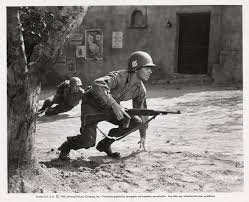
A Legendary American Soldier
Audie Leon Murphy (Born June 20, 1925 – Died May 28, 1971) is considered, by most military historians, the most decorated American combat soldier in the history of the American Military. To learn why, keep reading.
France – January 1945
The snow crunched under Audie Murphy’s boots as he crouched in the forward command post near Holtzwihr, France. It was January 26, 1945, just three months after receiving a battlefield commission to Lieutenant. A bitter wind whipped across the Colmar Pocket, where Company B, 15th Infantry, 3rd Division, held a fragile line against the last German foothold in France. At nineteen, Murphy was small—barely five-foot-five and 120 pounds—but his voice carried steady as he barked orders into the field telephone, directing artillery onto the advancing enemy.
Six German tanks and waves of infantry surged forward through the white fields. The company was outnumbered and outgunned. Murphy ordered his men to fall back to prepared positions in the woods behind him. They obeyed, melting into the trees. He stayed.
A shell slammed into a U.S. tank destroyer to his right. Flames roared up its hull. The crew scrambled out and ran for cover. Murphy ignored the inferno. He kept calling fire missions, his directions dropping artillery shells among the Germans. Still the enemy came, infantry pressing close through ditches and snow.
When the burning tank destroyer’s .50-caliber machine gun fell silent, Murphy moved. He climbed onto the blazing vehicle, the heat blistering his hands and face. Ammunition inside could explode at any second. Alone on the turret, exposed on three sides, he swung the heavy gun into action.
The first burst cut down a squad crawling toward him through a ditch. German rifles and machine guns answered. Bullets cracked past his head and pinged off the metal. Murphy held the trigger, raking the advancing lines. Tanks paused without infantry support. For nearly an hour he fought through the blaze or the fire, killing or wounding roughly fifty Germans. Enemy soldiers reached within ten yards before his fire drove them back.
A sniper’s bullet tore into his leg. Blood soaked his trousers, but he kept firing until the ammunition belts ran dry. Only then did he slide off the wreck and limp through smoke and snow toward the woods. His men stared as he appeared, wounded and blackened from the smoke.
Murphy refused the medic. “Get the company ready,” he said. He reorganized the line himself and led the counterattack. The Germans, bloodied and leaderless, broke and retreated. Company B held the woods that had been their objective.
The burning tank destroyer still smoldered behind them. Murphy’s leg throbbed, but the line was secure. For that hour on the burning tank destroyer, and the fight that followed, he would receive the Medal of Honor.
Early Life
Born into poverty on a sharecropper farm in Kingston, Texas, as one of 12 children, Murphy faced hardship early. His father abandoned the family, and his mother died when he was 16, leaving him orphaned. He had limited formal education (about five years), worked chopping cotton, and was known for his marksmanship hunting to help feed the family. At just 5’5″ and 110 lbs, he was initially rejected by the Marines and paratroopers. Patriotic and desperate to help his family, Murphy adjusted his birth certificate to meet the age requirement for the U.S. Army and enlisted in 1942. He would later send money, direct allotments from his pay, to his older sister Corrine, who helped raise the younger siblings after their mother’s death.
WWII Heroism
Murphy served with the 15th Infantry Regiment, 3rd Infantry Division, seeing combat across North Africa, Sicily, Italy, France, and Germany—about 400 days on the front lines across nine campaigns. He was wounded three times and rose from private to first lieutenant (later major in the National Guard), earning a battlefield commission.
He received every U.S. Army combat valor award (33 total awards, citations, and decorations), plus honors from France and Belgium. Key among them:
Medal of Honor— For his actions on January 26, 1945, at the Colmar Pocket near Holtzwihr, France. At age 19, alone atop a burning M10 tank destroyer (after ordering his men to withdraw), he held off a German company (infantry and six tanks) for about an hour using the vehicle’s .50 caliber machine gun. Despite being wounded, he then led a counterattack. He was credited with killing or wounding dozens in this engagement alone.
He is widely regarded as America’s most decorated combat soldier of WWII and many consider him to be the most decorated enlisted soldier in U.S. history.
Post-War Career
After the war, Murphy became a national hero. Actor James Cagney helped launch his Hollywood career. He appeared in about 44 films, most notably starring as himself in the 1955 autobiographical film “To Hell and Back” (based on his 1949 book), which was a major success. He also wrote country-western songs and poetry.
He struggled with “PTSD” (then called “combat fatigue”), gambling issues, and financial troubles but advocated for veterans. He continued serving in the Texas National Guard and Army Reserve.
Death and Legacy
Murphy died at age 45 in a private plane crash in foggy weather near Roanoke, Virginia, on May 28, 1971. He was buried with full military honors at Arlington National Cemetery; his grave is one of the most visited there.
His story embodies courage, resilience, and the American spirit—from humble Texas roots to battlefield legend and Hollywood star. He remains an enduring icon of WWII heroism.